Showing posts with label New Zealand. Show all posts

Sunday, 11 November 2012

Lest We Forget: 11/11/12

In memory of the members of our family who gave their lives in the service of their country. This list has been updated from last year, with the addition of five more names to the World War 1 Roll of Honour. The list now contains three sets of brothers.


PoppyThey shall grow not old, as we that are left grow old:
Age shall not weary them, nor the years contemn.
At the going down of the sun and in the morning
We will remember them.

(Lawrence Binyon, For the Fallen, 1914) 


Died

Place

Rank

Name

Age

Regiment / Service

Afghan Wars
12 Jan 1842 Afghanistan Captain Edward Macleod Blair 38 Bengal Light Cavalry
Indian Mutiny
14 May 1858 India Major John Waterfield 40 Bengal Native Infantry
Boer War
14 Feb 1902 South Africa Artificer George Howard Clark 23 Queensland Imperial Bushmen
World War 1
25 Apr1915 France Private Richard Michael Ryan 25 Royal Irish Fusiliers
9 May 1915 France Corporal Charles Mulligan 28 Black Watch
9 May 1915 France Rifleman Thomas Stanley Groves 31 Royal Irish Rifles
27 Jun 1915 Belgium Private John Julius Groves 32 DCLI
24 Aug 1916 France 2nd Lieutenant Lawrence Ernest Bennett 22 Queen’s Regiment
15 Sep 1916 France Gunner Cyril William Coles 23 Tank Corps
18 Oct 1916 France 2nd Lieutenant Christopher Gilbert Durant 20 Worcestershire Regiment
10 Jan 1917 Egypt Captain Duncan James Nugent Blair 34 Royal Field Artillery
26 Mar 1917 Palestine Private William Gurney 21 Middlesex Regiment
19 Apr 1917 France Private Arthur Tom Munden 31 Hampshire Regiment
23 Apr 1917 France Lance Corporal Hubert Gurney 21 Middlesex Regiment
10 Jul 1917 Belgium Lieutenant Sanford William Shippard 21 North Lancashire Regiment
12 Aug 1917 Greece Private Ernest John Bentley 41 Durham Light Infantry
16 Oct 1917 France Private Frederick Alexander Drackett 21 Hampshire Regiment
9 Apr 1918 Palestine Lieutenant Gilbert Seymour Worsley Spencer-Smith 23 Hampshire Regiment
11 May 1918 France Captain Arthur Alexander Austen-Leigh 27 Royal Berkshire Regiment
18 Sep 1918 France Captain Eric Fairfax Bennett MC 20 Queen’s Regiment
           
World War 2
21 Jun 1940 at sea Sub Lieutenant Ian Reginald Winn Stileman 20 RNVR
21 May 1941 Crete Driver Robert George Davis 25 NZ Army Service Corps
28 Oct 1942 Egypt Private Ronald Archibald Halkett-Hay 34 Australian Infantry
3 Nov 1942 Egypt Lieutenant Nigel Aves Watson 22 Royal Hussars
13 Jul 1943 Italy Lieutenant Derek Pease Gregg 26 Glider Pilot Regiment

Tuesday, 6 September 2011

Merchant Navy records: Wreck, Rescue & Racism

My son in law's great grandfather, Leonard Harold Glenister, 1904-1995, was a merchant seaman. So when Find My Past released their new collection of Merchant Navy records last week I looked him up.

The records are index cards created by the Registrar General of Shipping and Seamen for all those serving on British merchant navy vessels from 1918 to 1941. The front of each card contains biographical information plus a description and, if you are lucky, there is a photograph on the back, together with details of ships on which the person served.

I duly found a card for him, covering the period 1918 to 1921. He joined the merchant service as a "Deck Boy" in 1918, aged 14.  He was only 4 foot 7 inches in height, with light brown hair and grey eyes. He looked very solemn and worried in his photograph.

Glenister Leonard Harold 1918

Find My Past have included a helpful link to the Crew List Index Project, to identify the names of ships from the official numbers used on the index cards. From CLIP I learned that Leonard's first ship, which he joined on 23 January 1919, was the SS Zealandic. Constructed by Harland and Wolff in Belfast, she was launched in 1911 and owned by the White Star Line, of Titanic fame. Her home port was Liverpool. In 1917 she was commandeered by the Royal Navy for the transportation of troops and was still being used for that purpose when Leonard joined her, sailing between Liverpool and Wellington in New Zealand. Troops returning home were carried in one direction and meat from New Zealand in the other.

SS Zealandic

On 13 January 1920, Leonard moved to his second ship, SS Athenic, also owned by the White Star Line. She was a passenger liner, built in Belfast by Harland and Wolff and launched in 1901. She carried 121 passengers in first class, 117 second class and 450 third class. The ship was equipped with electric lighting and cooling chambers for the transport of frozen lamb. Like the Zealandic, she sailed on the New Zealand route.

SS Athenic

Leonard Glenister's voyage on the Athenic turned out to be rather eventful. I have pieced together the following account of what happened from  newspaper reports in the United States and New Zealand.

On her outward journey from London to Wellington, via the Panama Canal, the Athenic was carrying 500 homebound New Zealand soldiers. On 2 February they were docked in Newport News, Virginia, where an influenza epidemic was raging. The soldiers were forbidden to go ashore but 50 of them defied the order. Their commanding officer promptly reported them to the local police and they were arrested as deserters. According to the newspaper report, "They resented the charge of being deserters, but were herded back to their ship without difficulty after a brief stay in the police station". Athenic was due to sail the following day but was kept in port for a further three days by a fierce storm which brought 50 mph winds and huge waves.

Björn Larsson's Maritime Timetable Images

The return journey was even more dramatic. On Sunday 2 May 1920, an American steamer, the SS Munamar, on a voyage from Antilla, Cuba to New York, ran aground on a reef off San Salvador Island in the Bahamas. The ship was in a very dangerous position and taking on water fast, so the passengers were all put into the lifeboats. Athenic was in the vicinity and received Munamar's SOS call about 9pm. The first Athenic's passengers knew of the incident was when her engines suddenly stopped. It was too dark to effect a rescue but fortunately it was a calm night, so the Munamar's passengers sat in their lifeboats, whilst the Athenic circled, waiting for dawn. At daybreak on 3 May the 83 passengers from the Munamar were rescued, and their baggage and the mails salvaged from the stranded ship. The whole operation took about two hours.

Björn Larsson's Maritime Timetable Images

Athenic had a full passenger list and no empty berths, so the Captain ordered beds to be made up in the public rooms for the new arrivals. Unfortunately, this led to an ugly display of racism. 30 of the rescued passengers were black and the other Munamar passengers objected strongly to sharing accommodation with them. They "made a great many complaints" but the Captain of the Athenic stood firm. No doubt all concerned were very relieved when the Athenic landed the Munamar's passengers at Newport News, three days later. From there they made their way to New York by train.

The Munamar was eventually floated off the reef, after 2,000 bags of sugar from her cargo were thrown overboard, and taken to a dry dock in Jacksonville, Florida, for repairs. She then returned to service between Cuba and New York. Some time later, Captain Crossland of the Athenic was given a gold watch by President Warren Harding, in recognition of his ship's rescue efforts.

Sunday, 6 February 2011

Waitangi Day - Thomas Bluett, Wellington, 1841

February 6th is Waitangi Day, New Zealand's national day, which commemorates the signing of the Treaty of Waitangi on 6 February 1840. To mark the day, the Auckland Research Centre have issued an invitation to blog about New Zealand ancestors.
 

New Zealand flag


My 3x great grandfather, Thomas Bluett, was born around 1819. On 4 December 1836 he married Mary Langley at St Mary, Lambeth, Surrey. Mary had been born in Ireland around 1813, the daughter of Thomas Langley. Thomas and Mary had two known children. Their first child was a son, Thomas, whose birth has not yet been traced. Their second was a daughter, Mary Ann, who was born at 34 Little Pulteney Street, Westminster, on 3 March 1839. It is through her that I am descended. Mary Ann's birth certificate states that Thomas was a printer and we know from other sources that, at this time, he was employed as a lithographic printer by Day and Haghe of London, the country's leading lithographic printing firm.


Lithographic press 1855


On 17 September 1840, Thomas Bluett's name was entered in the New Zealand Company's register of emigrant labourers applying for free passage to New Zealand. He gave his age as 21 and his occupation as smith and bellhanger. Thomas was said to be married, with a wife aged 25, boy aged three and a girl aged eleven months, and the family were living at 50 St Clement's Lane, Strand, London.

On 27 September 1840, there was another Bluett application. Adam Bluett was registered as a smith, living at 18 Union Place, Sloane Square, Chelsea. He was aged 30, with a wife aged 29, boy aged 12 and girl aged 10. On 20 October 1840, there were two further applications. Another Adam Bluett, differentiated from the first by the designation senior, was a locksmith and bell hanger, resident at 50 St Clement's Lane, Strand. He was married, aged 40, with a wife aged 38. Immediately after him in the register came an application from Peter Langley, an unmarried labourer, aged 21 and also resident at 50 St Clement's Lane.


St Clements Lane cropped


After seven years' research, the relationship between these various groups of people is still unclear but, from the coincidence of names, occupations and addresses, it can hardly be doubted that there is one. Some of the information given in the applications is false - Thomas' occupation and Mary Ann's age were probably altered in order to qualify for free passage - but much has been proved accurate from other sources.

Thomas Bluett and his family were originally booked to sail on the Lady Nugent, which left England on 21 October 1840, but they delayed their departure, presumably in order to travel on the same ship as the others. At some point Adam Bluett junior and his family decided not to travel. He and his wife, Catherine (nee Sweeney), plus Adam's two children from a previous marriage, William and Betsy, can be found in the 1841 census living in Henrietta Street, Marylebone. So it was a party of seven which finally set sail on the barque Olympus from Gravesend on 9 December 1840, as steerage passengers bound for New Zealand. The passenger list notes that Thomas Bluett acted as cook for the voyage.

The Olympus arrived at Port Nicholson (the harbour of Wellington) on 20 April 1841. Thomas Bluett lost no time in getting to work but not as a smith and bellhanger. For he had brought with him in the hold of the Olympus the first lithographic printing press to reach New Zealand. Moreover, one of the cabin passengers on the Olympus was a lithographic artist, Jacob William Jones. It seems highly improbable that this was a coincidence. On 1 May 1841, the New Zealand Gazette announced:


1 May 1841 cropped


On 29 May, Jones and Bluett produced a chart of Port Nicholson, the first printed map in New Zealand:


Port Nicholson chart


By 12 June they had added a plan of Wadestown and a view of Lambton Harbour & Mount Victoria from Tinakore:


Lambton Harbour


By 17 July the Gazette was selling their plans of the town:


Wellington plan


But then it all began to go wrong. 16 September 1841 saw the publication in Wellington of the first, and only surviving, edition of an extraordinary newspaper, the Victoria Times. It was a lithographic print of a handwritten original and the publisher was Thomas Bluett, whose address was given as the Lithographic Printing Office, Wellington Terrace.
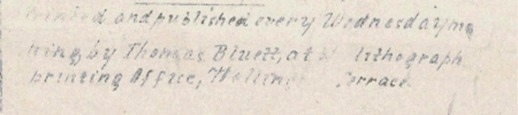
 

Litho office cropped


As was the custom, the first page consisted of advertisements, including one promoting Thomas Bluett's lithographic services on "very moderate" terms and another seeking "a steady and respectable lad as an apprentice to the lithographic business". The second and third pages were devoted to an editorial in the form of an extended diatribe against the Gazette. The fourth page reprinted the Jones and Bluett plan of Wellington:


Wellington map


From the plan, it can be seen that the Lithographic Printing Office was situated on land owned by Jacob William Jones. But, having alienated the Gazette, which had previously sold - and praised - his lithographic prints, Thomas now went on to alienate his collaborator and patron. The last mention of Thomas in New Zealand is an advertisement which appeared in the Gazette on 10 and 13 November 1841:
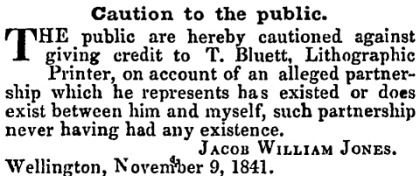
 

caution


By the end of the year, Thomas Bluett and his family had left New Zealand for Australia. Their many adventures thereafter, culminating in Thomas' headline-making death back in London in 1846, must be the subject of future blog posts.

As for their travelling companions on the Olympus, I can find no reference at all to them in New Zealand following their arrival. Peter Langley simply vanishes without trace but Adam Bluett senior and his wife, another Catherine, reappear in England. On 16 August 1849 they were convicted at the Wiltshire County Assizes of uttering counterfeit coin and each sentenced to one year's imprisonment. Adam died in the Workhouse in the parish of St Giles, London, and was buried in Victoria Park Cemetery, Hackney, on 27 December 1858, aged 59.

Sunday, 16 January 2011

Googling for Grandma - Old News is Good News

Newspapers are my favourite sources. They put flesh on the bones of our ancestors, turning dry and dusty genealogy into living, breathing family history. They cover all aspects of society and all areas of the globe and you are as likely to find a dustman as a duke in their pages.

Newspapers find their stories wherever there is human interest. With far less access to information than today, newspapers in the past frequently copied material from each other, and this practice crossed international boundaries. So although my family history is focused on the British Isles, I have found gems of information in papers in Australia, New Zealand, Canada and the United States. In the case of newspapers, it really does pay to "search outside the box" - and this is where Google comes in.

In 2008 Google launched an initiative to digitise historic news archives and make them searchable and accessible online. Content is drawn from global media such as the BBC, Guardian, Time Magazine and the New York Times but also from hundreds of small local publications. The period covered by each news archive varies - some only cover recent years, whilst the New York Times goes all the way back to 1851 - but all this information can be accessed in one place using Google News Archive Search.

Headline 2

I have had particularly good results when searching for my policeman great grandfather, John McCarthy. His promotion to be head of the CID got a good deal of coverage. My favourite is this article from a Newfoundland newspaper, the Harbor Grace Standard, dated 21 August 1912. The details are delightful:

Nobody who has met John McCarthy grudges him his promotion. He is a man without enemies, unless they be some of those desperate international criminals whom he has tracked down and arrested ... this jolly looking man with something of the farmer squire about his appearance ... Tall and broad shouldered he is built on a generous frame above the average in physique. He has the twinkling blue eyes of the Irishman ... Latterly he was busy with the suffragette agitations, and such was his charm of manner and courtesy that the women agreed that it was a pleasure to be arrested by Mr McCarthy.

But I learned from another newspaper that John had been tempted to jump ship at an earlier stage in his career. The St John Sun of New Brunswick reported on 1 April 1907:

Alfonso

During a visit to England, King Alfonso XIII was apparently so impressed by Scotland Yard detectives that he decided to revolutionise Spanish police methods. John McCarthy was offered the job of heading the new CID in Madrid, on a salary of $5,000 a year plus expenses. According to the newspaper, he was reluctantly obliged to decline the offer because he had been specially chosen to protect King Edward VII.

Of course, these articles concern a man in a prominent position in public life but I have had equal success finding information about more obscure family members. My great grandfather's brother, Clement Lawrence Scott Davis, disappears from the English records after the 1871 census. A handwritten family tree records that he ended up in the Nokomai region of New Zealand, prospecting for gold. The Google News Archive includes material from Papers Past in New Zealand and a search on Davis and Nokomai turned up an article he had written for the Otago Witness in 1886, describing a prospecting expedition:

Nokomai

Shortly after writing this, Clement disappeared on another prospecting trip in the mountains. A young man in his 30s, he left no family, no photographs and few details of his life have come down to us. This lengthy newspaper article is the only link we have to the man and his personality.